


In today’s 24/7 news cycle, it’s easier now more than ever to get emotional in trying to predict what the future holds. Its most evident in the current election cycle where everyone is clamoring as to how the world will not function if the opposing party wins, or the current party wins (depends on what you watch). This shouldn’t come as a surprise to anyone and is very typical in the polarized political world. However, what has me a tad bit concerned is that I’m seeing these emotional tendencies that are typically equated with politics, creep into individual’s financial planning and investment decisions. The concerns and emotional reactions are totally understandable with just how crazy this year has been- yet it is also worrisome when it comes to individuals long term retirement plans.
As you see in the chart below, this year from an investing perspective has looked and felt like a roller coaster. Early in the year we had stocks move to all-time highs, only to fall at a record pace in late March, where some portfolios were down 40-50% from their peaks. This without a doubt has been a very emotional year for investors. Not to mention throwing in a global pandemic and presidential election like we’ve never seen, will certainly add to the hysteria.
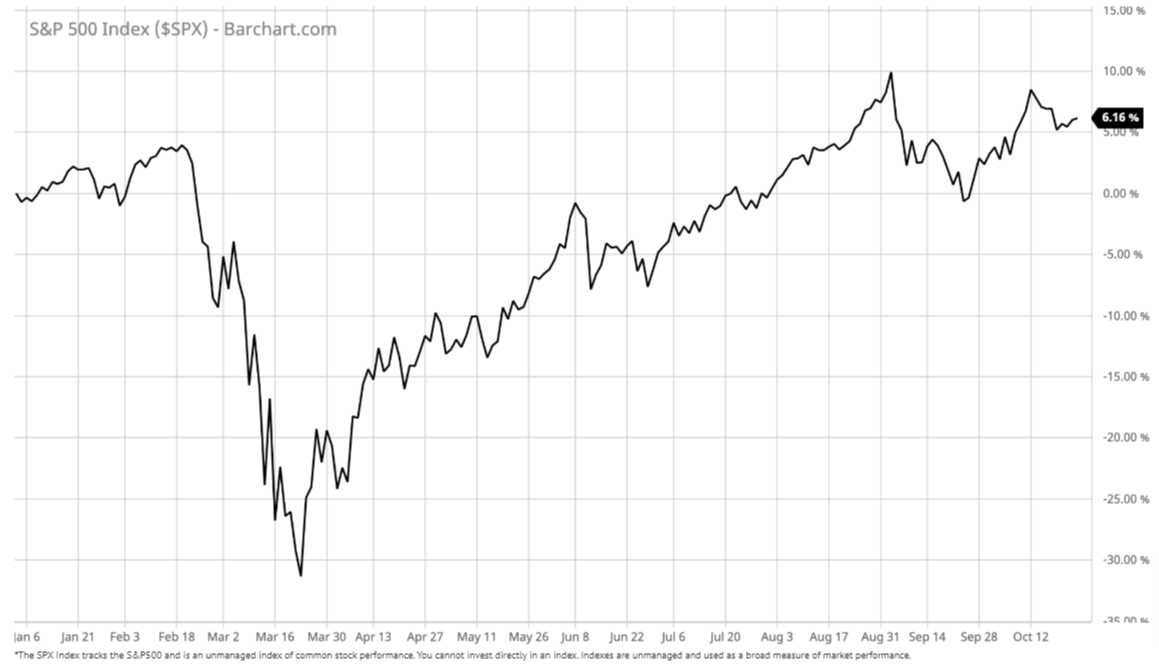
*The SPX Index tracks the S&P500 and is an unmanaged index of common stock performance. You cannot invest directly in an index. Indexes are unmanaged and used as a broad measure of market performance.
From here, we remain cautiously optimistic about markets. With a hopeful vaccination by early next year and a tremendous amount of pent up demand in the economy, there are definitely some positives to pull from going forward. In a world that can be so polarized, it’s important to focus on the good, just as much, if not more, than the bad. It is definitely easy to fall into the trap of wanting to own the big Tech stocks as they hit all-time highs, just like it would have been easy to claim the world was ending in March and sell everything. This is why it’s extremely important to continually assess your risk tolerance and feel comfortable knowing you have the correct asset allocation for your own Long-Term financial plan.
In closing, there are many uncertainties, which has and will create volatility. The market can continue to trade higher on negative news, as long as it is expected. What the market doesn’t like is the unexpected (think March’s uncertainty with duration of quarantine, etc.) My ask of everyone is to look at your short and long-term goals, if the market were to experience another environment like March, are you comfortable with how your risk tolerance is defined? Are you willing to stick to the Long-Term plan built around this risk tolerance if it takes one, three, five or ten years for the market to recover? If not, we need to talk and adjust course.
Stay well. Enjoy the day and talk soon! As always,
Frank
Disclaimer, all data cited herein is based on index returns. This presentation is for educational purposed only and is intended for use by Retirement Capital Advisors clients and contacts. No guarantees of investment returns are implied and investing entails risk including loss of principal.